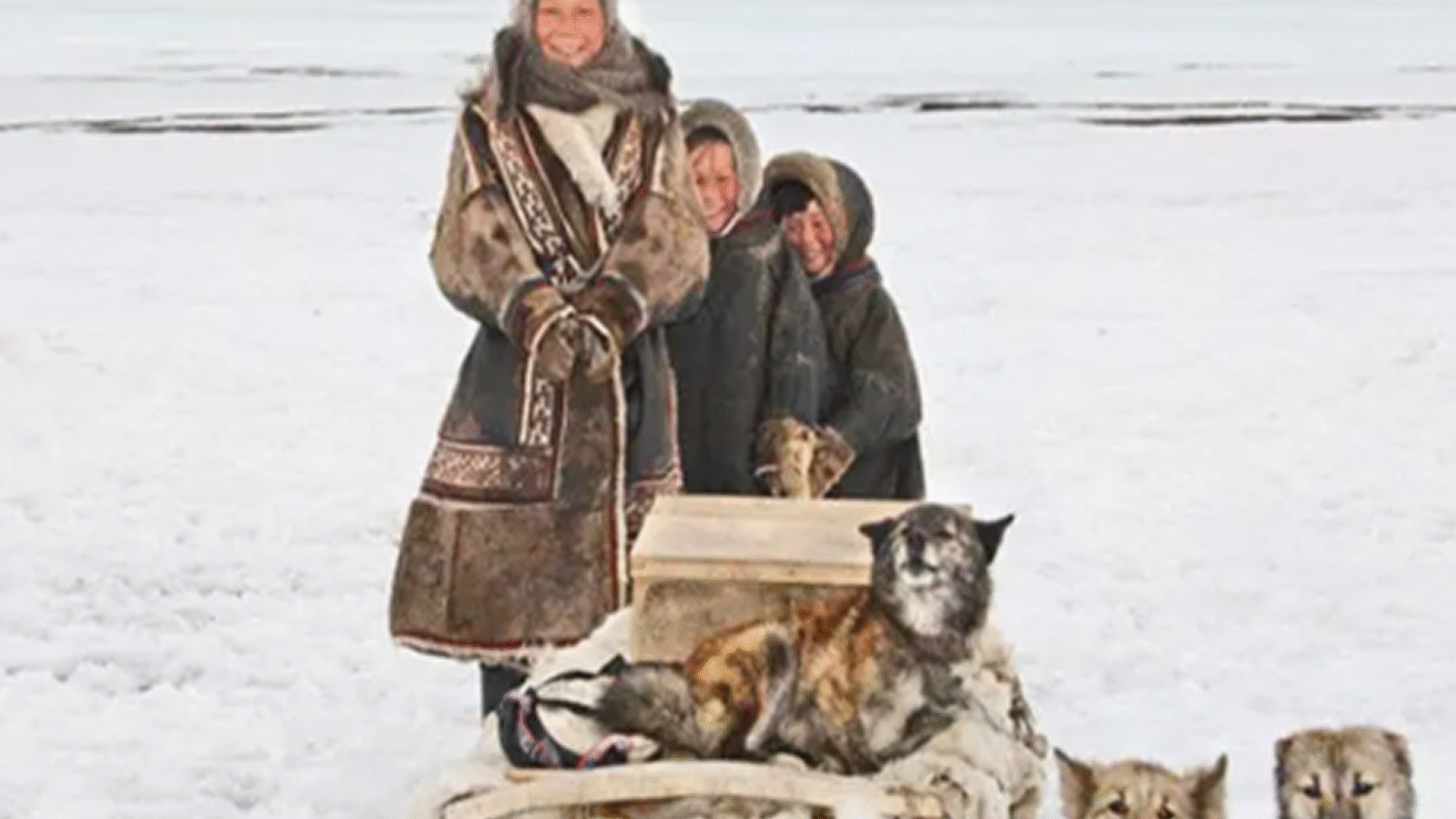
Travel back in time with Indigenous Russia. Did you know that the term refers to the original peoples of the Far North, Central and Southern Siberia, and the Far East—communities who have lived on the same lands and preserved their traditions for centuries? In 2000, Russian law officially recognized 41 such groups as the ‘Minor Indigenous Peoples of Russia.
Indigenous Russia, who are we referring to?
In Russia, only certain groups are legally recognized and protected as Indigenous peoples. To qualify for this status, a group must have fewer than 50,000 members, maintain a traditional way of life, inhabit designated remote regions of the country, and identify as a distinct ethnic group. Larger populations such as the Yakut, Buryat, Komi, and Khakas are excluded from recognition, while other groups continue to seek official status.
The smallest recognized Indigenous groups include the Enets (approximately 350 people) and the Oroks (around 450 people), while the largest are the Nenets and Evenks, each numbering close to 30,000. Some Indigenous peoples remain nomadic, migrating annually across the Arctic tundra with their reindeer herds. Others, particularly those in the forest tundra and taiga, live in settled villages and sustain traditional practices such as reindeer herding, hunting, fishing, and gathering—maintaining a close relationship with the natural environment

Nomads of Russia – Language and religion
The languages spoken among Indigenous groups in Russia are diverse, though many belong to the Uralic–Yukaghir, Altaic, and Eskimo Aleut language families.
Religion among Indigenous peoples of Russia is closely tied to nature. Most practice forms of animism, the belief that non-human entities—plants, animals, and natural phenomena such as the sun, moon, stars, water, and fire—possess spiritual essence. Each plant and animal is believed to have a soul. Ancestor worship is also central, with the conviction that honoring the spirits of ancestors, animals, plants, and natural forces such as earth and water can bring protection or solutions to problems.
Shamans serve as intermediaries between the human and spiritual worlds. In many Indigenous communities, shamans were revered, sometimes holding greater influence than tribal leaders. They conducted rituals involving drumming, dancing, and trance states often induced with the aid of intoxicating herbs. Shamans were also respected as healers, drawing on extensive knowledge of medicinal plants to treat illness.

The Nenets – largest indigenous Russia group
The Nenets, also known historically as Samoyeds, are one of the largest Indigenous groups of northern Arctic Russia, primarily inhabiting the Yamal Peninsula. For more than a thousand years, they have lived in this region far above the Arctic Circle, a harsh environment often referred to as ‘the end of the world,’ where ice and permafrost dominate most of the year.
Traditionally nomadic, the Nenets follow seasonal migration routes with their reindeer herds. In winter, they move south to the taiga forests for pasture, while in summer they travel north onto the tundra and permafrost lands. Reindeer are central to Nenets life, providing food, clothing, transportation, and shelter. Skins and bones are used to construct conical tents, known as choom or mya, while clothing is sewn from reindeer hides. Their diet relies heavily on reindeer meat—often eaten raw or frozen—as well as fish such as white salmon. In the summer months, they also gather cranberries and other wild berries. In times of necessity, when a reindeer becomes injured and cannot travel, the animal is slaughtered and its fresh blood consumed for essential nutrients.

xThreats to indigenous Russia

Today, Indigenous peoples of Russia face growing threats to their culture and traditional way of life. One of the most serious challenges is the shift toward a sedentary lifestyle and assimilation into Russian language and culture. The migration of Russian populations into northern regions over the past two centuries has profoundly affected Indigenous communities. Whereas 30 years ago, about 70% of Siberia’s Indigenous population lived nomadic or semi-nomadic lives, today that number has dropped to only about 10%.
Since the collapse of the Soviet Union, many young people have left villages for larger cities. Unfortunately, many struggle to adapt to urban life, facing issues such as unemployment, alcoholism, and mental health challenges.
Environmental change is another pressing issue. Climate change is melting the permafrost, undermining land, infrastructure, and traditional migration routes, while resource extraction and industrial pollution add further pressure. As Nenets herder Sergei Hudi warns: ‘We are afraid that with all these new industries, we will not be able to migrate anymore. And if we cannot migrate anymore, our people may just disappear altogether.’
The Indigenous peoples of Russia have long demonstrated strength, resilience, and adaptability in preserving the lifestyles, cultures, and traditions of their ancestors. Today, it is also our responsibility to support them—helping ensure their survival and the continuation of a sustainable way of life.

Who are the indigenous people of Russia?
Russia is home to more than 100 recognized ethnic groups. Of these, 41 are legally designated as the “Indigenous small-numbered peoples of the North, Siberia, and the Far East.” These groups are the only communities afforded specific legal protection as Indigenous peoples. To qualify, a group must have fewer than 50,000 members, maintain a traditional way of life, inhabit remote regions, and identify as a distinct ethnic group. Larger populations such as the Sakha (Yakuts), Buryat, Komi, and Khakas are excluded from this designation, while other groups continue to seek recognition.
In addition, 24 larger ethnic groups are identified as nationalities or titular nations. These groups inhabit autonomous republics or territories within Russia but do not enjoy the same legal protections.
The smallest recognized Indigenous groups include the Enets (about 350 people) and the Oroks (around 450 people), while the largest are the Nenets and Evenkis, each numbering close to 30,000. Of the 41 recognized groups, ten have populations under 1,000, and eleven live beyond the Arctic Circle. At least 16 groups are considered endangered due to their small numbers, and 11 have already been declared extinct. While Indigenous peoples represent just 0.2% of Russia’s total population—about 250,000 individuals—they inhabit roughly two-thirds of Russia’s vast territory.
Although highly diverse, many Indigenous communities share certain traits. They are often nomadic or semi-nomadic, practice animism, and maintain traditional subsistence activities such as hunting, fishing, gathering, and reindeer herding. The preservation of these lifeways has become even more significant since the collapse of the Soviet Union. Linguistically, Indigenous peoples of Russia belong mainly to the Uralic, Altaic, and Paleo-Siberian families.
Legal and Political Challenges
Despite constitutional protections under Article 69 of the Russian Constitution, enforcement of Indigenous rights has often been inconsistent. Russia has not ratified the ILO Convention 169 on Indigenous and Tribal Peoples. Conflicts frequently arise between Indigenous land use and industrial resource extraction; as of recent years, there are around 70 documented disputes related to mining, oil and gas development, and infrastructure projects. For example, nickel mining has encroached upon reindeer pastures and sacred sites.
In 2001, Russia passed the law “On the Territories of Traditional Nature Use” (TTNU), intended to secure land-use rights for Indigenous peoples. However, no TTNU has yet been formally established. Fishing rights also remain restricted: since 2008, Indigenous peoples may fish only for personal use, excluding Indigenous cooperatives (obshchinas) that traditionally provided both income and employment.
Institutional support has weakened over time. In 2011, the Federation Council’s Committee on Northern and Indigenous Affairs was dissolved, along with several regional agencies. In 2012, the government suspended the activities of the Russian Association of Indigenous Peoples of the North (RAIPON), which had represented 42 Indigenous groups and held permanent membership in the Arctic Council. That same year, a law labeled non-profits receiving foreign funding and engaging in advocacy as “foreign agents,” burdening many Indigenous rights organizations with restrictions and stigma.
Social and Economic Issues
Indigenous communities in Russia face disproportionately high rates of poverty and unemployment. Joblessness is 1.5 to 2 times higher than in the general population, while incomes are 2 to 3 times lower. Many communities lack clean drinking water, adequate food supplies, and sufficient healthcare. These conditions contribute to elevated rates of tuberculosis, viral hepatitis, respiratory infections, and alcoholism. Tuberculosis alone occurs at three times the national average. Maternal and child mortality rates in some Indigenous regions exceed birth rates, and overall life expectancy is considerably lower—around 50 years for men and 60 for women, compared to 64 and 70 years respectively in the general population.
Cultural and Linguistic Threats
The traditional lifeways of Indigenous groups are also under severe pressure. Whereas about 70% of Siberia’s Indigenous population lived nomadic or semi-nomadic lifestyles 30 years ago, today only about 10% do so. Since 2002, 24 of the 41 recognized Indigenous groups have declined in population, with only 10 showing growth. Assimilation, combined with the large-scale migration of Russian populations into the North over the past two centuries, has eroded Indigenous cultural identity.
Language loss is especially acute. Russian-language education, boarding schools, and mass media have marginalized smaller languages; currently, 148 languages in Russia are considered endangered.
Resilience and Outlook
Despite these hardships, the Indigenous peoples of Russia have shown resilience and adaptability. They continue to draw strength from their cultural traditions and ancestral heritage. Having endured centuries of political repression, environmental challenges, and cultural marginalization, these communities remain determined to preserve their identity. With global attention increasingly focused on Russia and the Arctic, there may be renewed opportunities to support Indigenous peoples in their struggle for survival, recognition, and cultural continuity.